Traces in the Starlight

Where Winter Sports Continue at Night

When night falls over Osttirol, the world changes: the mountains fall silent, the stars seem closer, and amid the 266 three-thousand-meter peaks, an atmosphere unfolds that could scarcely be more serene and intense. When winter sports enthusiasts head outdoors at this moment, they have no idea what experiences the region south of the main Alpine ridge has in store for them in the darkness.

Osttirol's Dark Treasure

Hardly any other region in the Alps has as little light pollution as Osttirol. When the sun sinks behind the three-thousand-meter peaks, a spectacle begins there that has long since been lost in many places: true darkness. The wide valleys, sparse population, and a conscious approach to artificial lighting make the starry sky in this Austrian vacation region appear clearer than anywhere else.


The stars twinkle close enough to touch, and the Milky Way stretches like a silvery ribbon across the mountain peaks. The night between the Nationalpark Hohe Tauern, the Lienzer Dolomiten, and the Carnic Ridge is not only scenically beautiful: your breathing and movements find their own rhythm, and your thoughts grow calm.


Night owls enjoy the meditative effect of this special atmosphere—whether they’re out and about or simply taking a moment to pause. Tip for amateur astronomers: The starry sky is particularly well-suited for stargazing from the Lucknerhaus at an elevation of 1,920 meters, at Obersee on the Staller Sattel at 2,052 meters, or at the Dolomitenhütte at 1,616 meters.

Flow & Snow

A total of 400 kilometers of cross-country trails, ranging in elevation from 673 to 2,052 meters above sea level, blend seamlessly into the wintry valley landscapes of this Austrian mountain region. For years, Osttirol has been committed to providing cross-country trails of the highest quality, modern infrastructure, and reliable snow conditions. It is precisely the combination of intense full-body exercise and the proximity to a total of 266 three-thousand-meter peaks that makes Nordic skiing so appealing there.


Whether it’s gentle valley loops or challenging high-altitude trails—the powerful glide through the silence demands muscular strength, promotes mental relaxation, lets your thoughts wander, and clears your mind. It’s ideal to set out on perfectly groomed trails after work and as darkness falls: The Lavant Loop (3 kilometers), the Blusenrunde in Prägraten (1.4 kilometers), and the St. Jakob–Grünmoos trail (2 kilometers) are all illuminated until 9 p.m. and are suitable for both classic and skating styles.


For those who want to train like top athletes, however, the Tyrolean Gail and Tiroler Lesachtal Valleys—with their international cross-country skiing and biathlon center in the mountain village of Obertilliach —are also attractive to professional cross-country skiers, national team members, and training programs thanks to their high altitude, infrastructure, and lighting until 7 p.m.

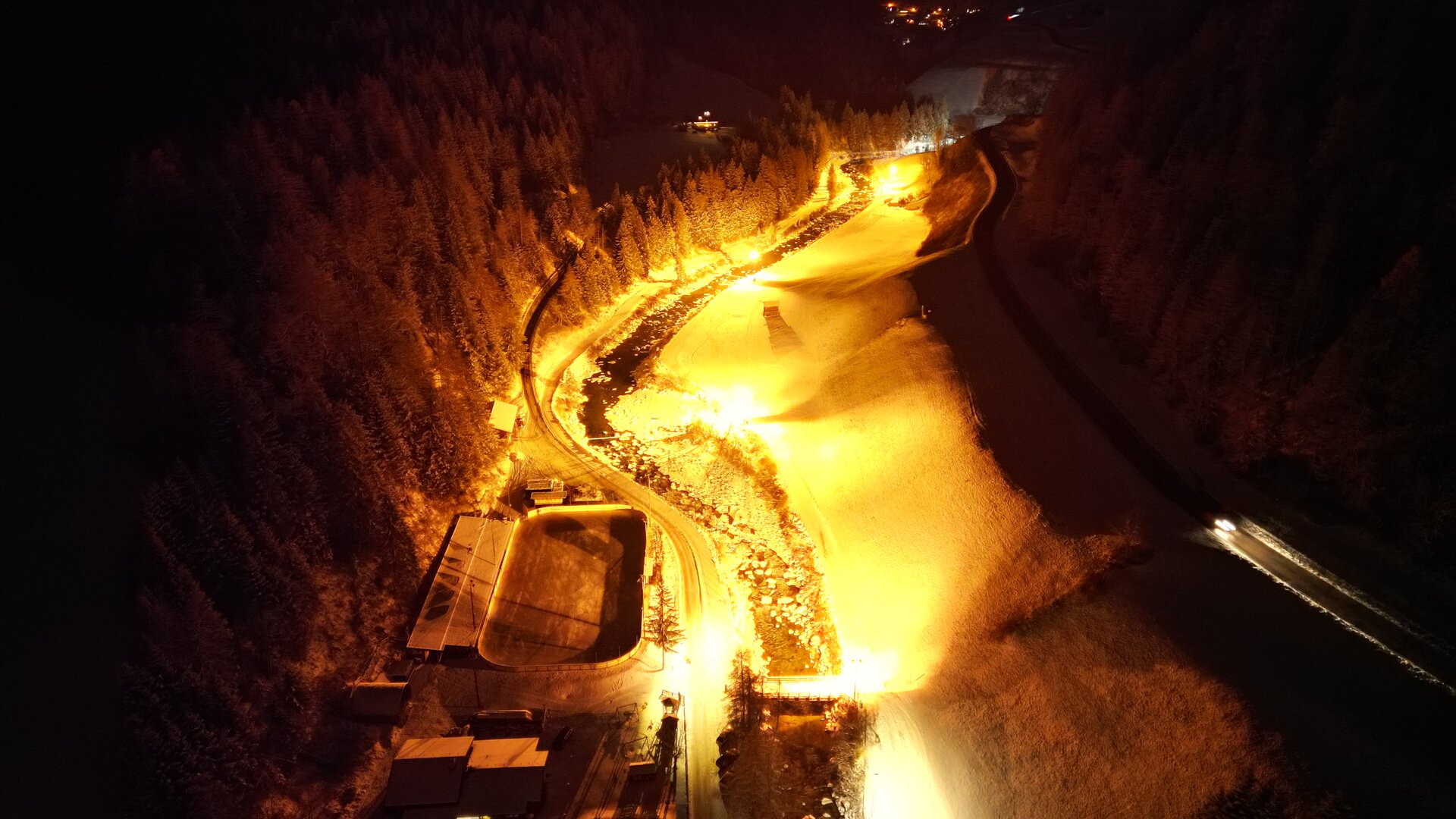
Die Loipe der Blusenrunde in Prägraten ist beleuchtet neben dem Fluss bei Nacht.

Nights Full of Possibilities

The seclusion of the valleys, the vast expanses of the Nationalpark Hohe Tauern, and the unspoiled natural beauty of the landscape create ideal conditions for outdoor activities under the starlight. Night tobogganing on the region’s numerous natural toboggan runs is particularly popular. Equipped with headlamps or under floodlights, you’ll whiz down into the valley, often with a cozy stop at an inn to start or end the evening.


This is also the case at the foot of the Rauchkofel on the Lienzer Dolomiten natural toboggan run in Leisach (1.1 km), with a total of seven hairpin turns; on the Alpe Stalle in St. Jakob (1.8 km) in the Defereggental valley, where a detour to Bruno’s mountain hut at an altitude of 1,714 meters is well worth it, or on the Winkeltal/Tilliachalm trail in Außervillgraten, which is even certified with the Tyrolean Natural Toboggan Run Seal of Quality.


For a more athletic pace, try night skiing in Kartitsch and Virgen, where perfectly groomed slopes are open once or twice a week into the evening hours for carving runs under the spotlights. The torchlight hike around the frozen Tristacher See is quieter but no less atmospheric: in the warm glow of the flames, the winter sky is reflected on the ice, while the surrounding larch and spruce trees blur into the darkness.
Newsletter

Subscribe to our newsletter and receive the best tips every month for current offers, mountain tours, events and much more.